October 12, 2026 · Sail Into Tech
AI investment is pulling a wide set of technology jobs with it
The loud version of the AI jobs story is a single role: an engineer with the model in the job title, hired by a lab. The hiring data from this autumn describes something wider. Employers are advertising ordinary technology work, in large numbers, and a growing share of those ads now ask for an AI skill on top of the job the person was already going to do.
CompTIA’s reading of September, released October 2, put active US postings for IT occupations at 625,633, the highest total in more than three years. Employers wrote 272,040 new openings in the month. New postings were up 16% on September 2025, and the active total was up 22.4%. Software developers and engineers were still the largest single bucket, with 47,598 new openings, up 8.3% from August. Systems engineers, tech support, data analysts, and DevOps engineers followed. Sixteen of the twenty industries CompTIA tracks advertised more tech jobs than they had in August.
That is the surge. It is a technology hiring wave, and software is still the middle of it.
The spend is what moved the ads
Stanford’s 2026 AI Index puts private AI investment in the United States at $285.9 billion in 2025. The same report counts 5,427 data centers in the country, more than ten times any other country, with almost every leading chip still fabricated by one foundry in Taiwan. In the economy chapter, organizational adoption of AI reached 88%. Generative AI is in at least one business function at 70% of organizations. Among people, generative AI reached 53% adoption in three years, faster than the personal computer or the internet. The United States ranks 24th on that population measure, at 28.3%, even while it leads the investment tables. The Index estimates the tools are already worth about $172 billion a year to US consumers.
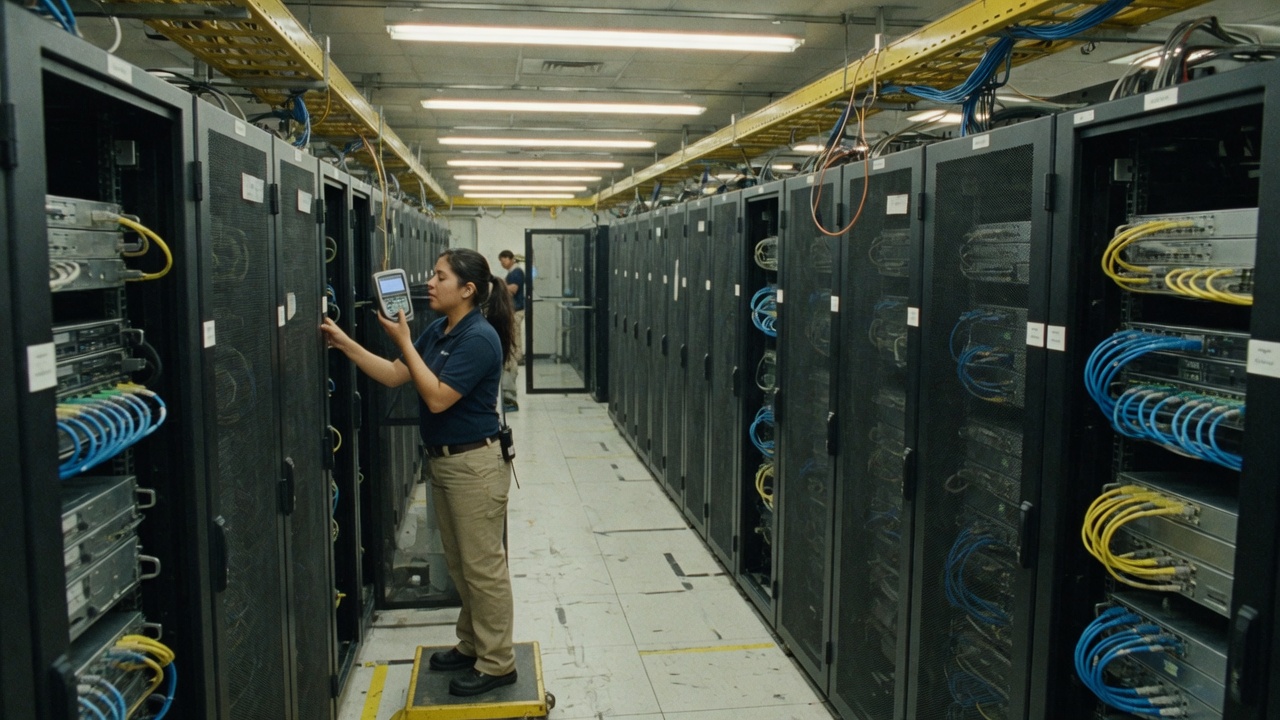
Those figures are not hiring statistics. They are why the hiring statistics moved. A company buying models, standing up a hall, or pushing an assistant into one function needs people who can build the software, run the systems, support the users, and watch the data.
CompTIA’s September count of active postings that ask for an AI-related skill was 349,821, up 32,327 from August and about 282% since May 2024. That series covers the wider labour market, so it is not a subset of the 625,633 IT openings. The dedicated AI and machine-learning job titles are the smaller number: 13,636 active postings, close to triple the May 2024 level. The skill is spreading through existing jobs faster than the new title is.
CompTIA’s State of the Tech Workforce, published in March, expects net US tech employment to grow 1.9% in 2026, about 185,500 jobs, after a 0.3% dip in 2025. Over the next decade it expects tech occupations to grow at about twice the pace of US employment overall. Using Bureau of Labor Statistics and Lightcast projections, it puts data scientists and analysts at 420% of the national growth rate, cybersecurity analysts and engineers at 346%, and software developers and engineers at 188%.
Seth Robinson, CompTIA’s vice president of research, described September as a month when employers stayed cautious about hiring and still wanted the core skills that let a company adopt AI with some discipline. The technology sector itself shed an estimated 10,350 jobs in the month, on CompTIA’s reading of the Bureau of Labor Statistics, while postings across the wider economy rose. Demand for the work, and employment inside technology companies, are different series.
New work is showing up beside the old titles
Some of the demand has its own name. The Index’s responsible-AI chapter says AI-specific governance roles grew 17% in 2025, and the share of businesses with no responsible-AI policy fell from 24% to 11%. That is a small profession next to software development. It is also a job that barely existed in the ads a few years ago: someone whose work is the evaluation, the policy, and the record of what a model did.
The larger change is inside jobs that already had names. A software opening that asks for retrieval, evaluation, or a model API is still a software opening. A support role that asks someone to supervise an assistant is still a support role. On SWE-bench Verified, a coding benchmark the Index tracks, performance moved from 60% to near 100% in a single year. That is why those lines are appearing in ads. The tool got good enough that employers started writing it into the job.

The first job is the part that did not surge
The same sources that show the surge also show who is not being carried by it. The 2026 AI Index says employment of software developers aged 22 to 25 in the United States has fallen nearly 20% from 2024. Stanford’s Digital Economy Lab, in an August revision of its canaries paper with ADP payroll data through June 2026, finds no economy-wide job collapse. It does find that employment of workers aged 22 to 25 in AI-exposed occupations sits about 19% below where it would be if it had kept pace with less-exposed peers. The gap shows up as fewer hires, rather than a wave of layoffs, and it is sharper where the tool substitutes for the task than where it complements the person doing it.
One-third of organizations in the Index’s employer survey expect AI to reduce their workforce over the coming year. Almost half expect little or no change. The functions where those expectations run highest are service operations, supply chain, and software engineering, and in nearly every function the reduction employers expect is larger than the reduction they say has already happened. That is a forecast. It belongs next to the posting boom, because both can be true at once: more ads for people who have already done the work, and a narrower door for the person who used to learn the job by doing the routine parts.
If you are early in a technology career, the useful reading of September’s numbers is specific. The industry is hiring. The ads are for developers, systems engineers, support, data, and a thinner set of specialist AI titles. They are also, increasingly, written for someone who has shipped the system before.
References
- CompTIA, “Employer demand for tech talent reaches three-year high,” September 2026 analysis, released October 2, 2026
- CompTIA, State of the Tech Workforce 2026, March 2026
- Stanford Institute for Human-Centered AI, 2026 AI Index Report
- 2026 AI Index, Economy
- 2026 AI Index, Research and Development
- 2026 AI Index, Responsible AI
- Brynjolfsson, Chandar, and Chen, “Canaries in the Coal Mine?” Stanford Digital Economy Lab, revised August 12, 2026